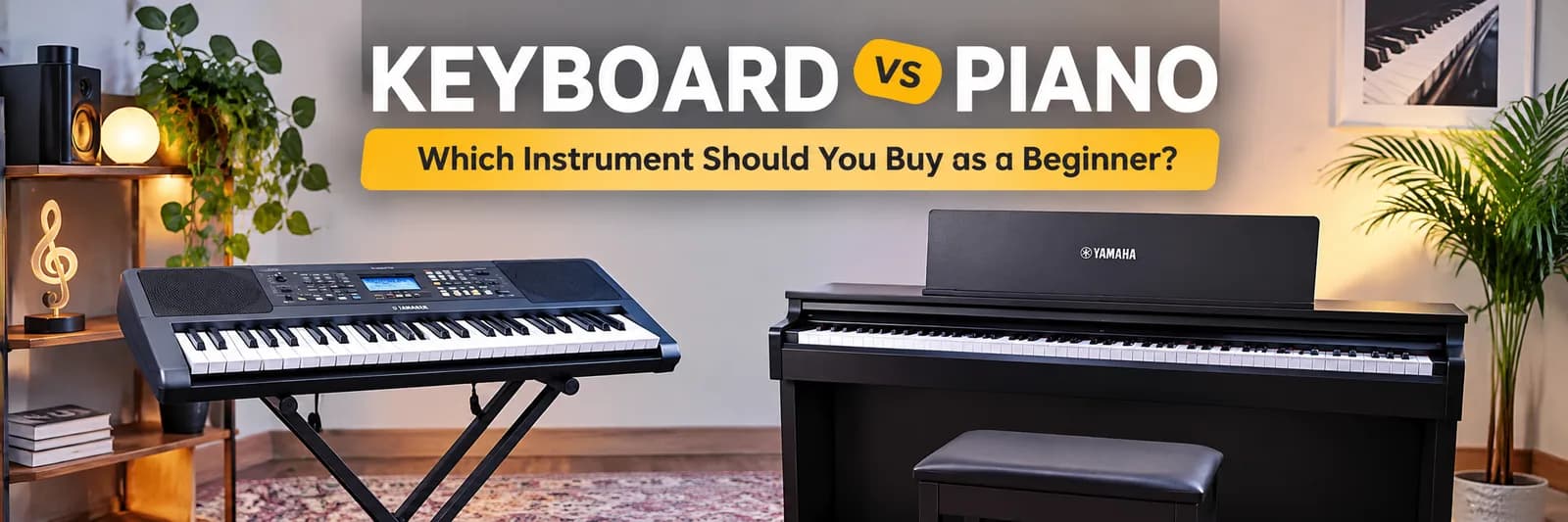
Keyboard vs Piano: Which Instrument Should You Buy as a Beginner?
Choose the Yamaha PSR-E383 or PSR-EW320 for flexible keyboard learning; pick the Yamaha P-145 for 88-key, weighted piano practice as a beginner with ease.
- 8 min read
In this article
Reading · Keyboard vs Piano: Understanding the Main Differences
0%- 01Keyboard vs Piano: Understanding the Main Differences
- 021. Number of Keys: How Many Do You Really Need?
- 032. Key Sensitivity and Touch Response: Why Does It Matter?
- 043. Sound Options and Creative Freedom
- 054. Portability, Space and Everyday Convenience
- 065. Keyboard vs Piano: Which One Is Better for Your Learning Goals?
- Choose a keyboard if :
- 076. Exploring Yamaha Instruments for Beginners
- 08A Few Things to Check Before Buying Your First Instrument
- 09Conclusion: Choose the Instrument That Inspires You to Play
- Frequently Asked Questions About Keyboard vs Piano
Buying your first musical instrument is exciting, but the choices can quickly get confusing. You may have already explored a few models, watched musicians play online or visited a music store, only to find yourself wondering about one thing: Keyboard vs piano, which one is actually right for you?
While both instruments share the familiar black and white keys, they offer different ways to experience music. A keyboard lets you experiment with sounds, create rhythms and play along with your favourite songs. A piano, on the other hand, offers a more traditional playing experience that helps you focus on technique, finger movement and musical expression.
The interesting part is that neither choice is wrong for a beginner. It all comes down to what you enjoy playing, how you want to learn and where you see your musical interests taking you. Before spending money on your first instrument, let's look at what really sets them apart and what you should consider.
Keyboard vs Piano: Understanding the Main Differences
Although both instruments share a similar layout, their purpose and construction are different.
A keyboard is generally an electronic instrument designed to offer multiple sounds, rhythms and creative features. Depending on the model, you can play piano, guitar, strings, drums, organs and several other instrument sounds. Many keyboards also include built-in accompaniment styles and learning functions.
A piano, particularly an acoustic piano, produces sound through a mechanical system of hammers striking strings. A digital piano recreates the sound and playing experience of an acoustic piano electronically. Most digital pianos are designed with weighted keys to provide a more realistic playing feel.
Here is a simple comparison.
Feature | Electronic Keyboard | Digital Piano |
Keys | Commonly 61 or 76 | Generally 88 |
Key action | Usually lighter | Weighted or hammer action |
Sounds | Multiple instrument sounds | Primarily piano-focused sounds |
Rhythms | Often includes accompaniment styles | Usually limited |
Portability | Generally lightweight | Varies by model |
Learning focus | Versatile music exploration | Piano technique and expression |
Best suited for | Hobbyists, beginners and performers | Aspiring pianists and piano students |
Both instruments can help you develop musical skills. The difference lies in the experience you want from your instrument.
1. Number of Keys: How Many Do You Really Need?
One of the first things you will notice while shopping is the number of keys.
A standard acoustic piano has 88 keys, covering a wide musical range. Digital pianos generally follow the same layout, making them suitable for learning classical pieces, advanced compositions and music that requires a broader range of notes.
Portable keyboards commonly come with 61 or 76 keys.
A 61-key instrument offers five octaves, which is sufficient for many beginner lessons, popular melodies, basic chords and everyday practice. A 76-key instrument provides additional notes, giving learners more room to explore songs that require a wider range.
Which should you choose?
61 keys: Suitable for first-time learners, casual playing and exploring different musical styles.
76 keys: A practical option if you want additional playing range without moving to a full-size instrument.
88 keys: Recommended for learners following structured piano lessons and developing long-term piano skills.
Remember, having more keys does not automatically make someone a better musician. What matters is choosing an instrument that supports the music you want to learn.
2. Key Sensitivity and Touch Response: Why Does It Matter?
Imagine playing the same musical note in two different ways. In one attempt, you press the key gently. In another, you press it firmly.
Should both notes sound exactly the same?
Ideally, no. Musical expression comes from controlling how softly or strongly you play.
Touch-sensitive keyboards respond to the pressure applied to the keys. Press harder and the sound becomes louder; press gently and the sound becomes softer. This helps beginners understand dynamics and develop better control over their playing.
Digital pianos take this experience further with weighted or graded hammer-action keys. These keys are designed to recreate the resistance and response of an acoustic piano. On many models, the lower notes feel heavier than the higher notes.
This difference becomes important when you start practising finger strength, control, scales and expressive piano pieces.
Beginner tip: Even if you purchase an affordable keyboard, look for touch-sensitive keys. They provide more room to develop your musical expression as your skills improve.
3. Sound Options and Creative Freedom
This is where electronic keyboards offer an exciting experience.
Imagine playing a melody using a grand piano sound, switching to an electric piano, experimenting with a guitar tone and then adding drums and rhythm accompaniment.
You can explore all these possibilities on a feature-rich electronic keyboard.
Many Yamaha portable keyboards offer hundreds of instrument Voices, accompaniment Styles, built-in songs and creative effects. These features make practice more engaging, especially for people who enjoy experimenting with different musical genres.
Digital pianos generally concentrate on delivering a realistic piano sound and playing experience. Some models offer additional instrument voices, but their primary purpose is to recreate the feel of playing an acoustic piano.
If you enjoy experimenting, composing simple arrangements or playing along with different rhythms, a keyboard can offer plenty of creative opportunities.
If your interest lies in mastering piano pieces and developing a strong foundation in piano performance, a digital piano may be the better choice.
4. Portability, Space and Everyday Convenience
Your first instrument should also fit comfortably into your everyday routine.
Portable keyboards are generally lightweight and easy to move. You can set them up on a keyboard stand, practise in your bedroom or carry them to music classes and small performances.
Many models also support battery operation, giving you additional flexibility.
Digital pianos are available in portable and furniture-style designs. Portable models can be moved when needed, but their weighted key mechanisms and larger 88-key layouts generally make them heavier than entry-level keyboards.
If you live in an apartment, have limited room or need an instrument that can be stored after practice, a portable keyboard is worth considering.
If you have a dedicated practice area and prefer a full-size playing layout, a digital piano can be a wonderful addition to your home.
5. Keyboard vs Piano: Which One Is Better for Your Learning Goals?
Instead of purchasing an instrument simply because it looks attractive, think about what you want to achieve in the next six to twelve months.
Choose a keyboard if :
You are exploring music for the first time.
You want to learn popular songs and melodies.
You enjoy experimenting with different instrument sounds.
You want to explore rhythms and accompaniment.
Portability and flexible practice matter to you.
You want an accessible starting point for learning music.
Choose a digital piano if :
You specifically want to become a pianist.
You plan to attend structured piano lessons.
You want to practise classical and contemporary piano pieces.
You want weighted keys and a piano-like playing experience.
You want to develop proper piano technique over time.
There is no universally correct choice. A keyboard is not necessarily a temporary instrument, and a digital piano is not automatically the right purchase for every beginner.
Your musical interests should guide your decision.
6. Exploring Yamaha Instruments for Beginners
Once you understand your requirements, choosing a reliable instrument becomes easier. Yamaha offers a range of portable keyboards and digital pianos designed for different learning needs.
Here are three models worth exploring.
Yamaha PSR-E383: A Versatile First Keyboard
The Yamaha PSR-E383 is a 61-key portable keyboard designed for beginners and music enthusiasts.
It includes 650 instrument Voices, 260 accompaniment Styles and a touch-sensitive keyboard. Its learning features, including Keys to Success and 3-Step Lesson, help beginners practise songs at their own pace.
It also offers Duo Mode, USB Audio/MIDI connectivity and battery operation.
Ideal for: First-time learners who want to explore melodies, different instrument sounds and basic music arrangements.
Yamaha PSR-EW320: More Keys, More Possibilities
If you want additional playing range, the Yamaha PSR-EW320 is worth considering.
It features 76 touch-sensitive keys, 650 Voices and 260 accompaniment Styles. It also includes built-in songs, lesson functions, Auto Chord Play and USB Audio/MIDI connectivity.
The additional keys provide more flexibility when exploring melodies and musical arrangements.
Ideal for: Beginners who want a wider keyboard range and enjoy experimenting with different musical styles.
Yamaha P-145: For Aspiring Pianists
For learners who specifically want to study piano, the Yamaha P-145 is an excellent model to explore.
It features 88 keys with Yamaha's Graded Hammer Compact (GHC) action, designed to recreate an acoustic piano-like playing experience.
Its compact design makes it suitable for home practice, especially for learners who want a full-size digital piano without purchasing a traditional acoustic instrument.
Ideal for: Beginners with a serious interest in piano learning, structured lessons and developing proper playing technique.
Always check the latest product specifications, availability and included accessories before purchasing.
A Few Things to Check Before Buying Your First Instrument
Before making the final purchase, spend some time checking these practical details.
1. Try the keys (H3): Visit a music store and play a few notes. Notice how the keys respond to your fingers.
2. Check the learning features (H3) : Built-in songs, metronomes and lesson functions can make independent practice more interesting.
3. Consider accessories (H3): A keyboard stand, adjustable stool, sustain pedal, headphones and power adapter can improve your practice setup. Check which accessories are included and which need to be purchased separately.
4. Think about future learning (H3): Consider the kind of music you want to play after six months or a year.
5. Get expert guidance (H3) : A music instructor or experienced instrument specialist can help you select a model that matches your learning requirements.
Conclusion: Choose the Instrument That Inspires You to Play
There is no perfect formula for choosing your first instrument. Some people discover their love for music through experimenting with keyboard sounds, while others enjoy the feel of playing a piano. What matters is finding something that makes you want to sit down and practise again tomorrow. Take your time, explore your options and choose what feels right. Visit our online store to explore a range of Yamaha keyboards and digital pianos and find the right companion for your musical journey.
Frequently Asked Questions About Keyboard vs Piano
Frequently asked questions
Keyboard vs piano: Which is better for beginners?
Both are suitable for beginners. A keyboard is ideal for exploring different sounds, rhythms and popular songs, while a digital piano is better suited to learners who want to develop traditional piano-playing techniques.
Can I learn piano on a 61-key keyboard?
Yes. You can learn basic melodies, chords, scales and several beginner songs. However, an 88-key digital piano is recommended for students following structured piano lessons.
Is a digital piano the same as an electronic keyboard?
No. A digital piano primarily recreates the sound and playing feel of an acoustic piano, while an electronic keyboard offers multiple sounds, rhythms and accompaniment features.
Which Yamaha keyboard is suitable for a first-time learner?
The Yamaha PSR-E383 is a good starting option, offering 61 touch-sensitive keys, multiple instrument sounds and built-in learning functions.
Should I buy a 61-key or 88-key instrument?
Choose 61 keys for general music exploration and beginner keyboard learning. Choose 88 weighted keys if your goal is to study piano seriously and develop long-term piano technique.
Do I need music lessons to learn an instrument?
Not necessarily. You can begin with built-in lessons, online tutorials and regular practice. However, guidance from a qualified music teacher can help you build correct technique and improve faster.